Wednesday, 16 March 2016

THE ART OF SHOPPING: CORNER STORES AND MARKETPLACES

THE ART OF SHOPPING: CORNER STORES AND MARKETPLACES

Lawren Harris "The Corner Store" 1912 (National Gallery of Canada, Ottawa),

Helen McNicoll "Marketplace" 1910 (Robert McLaughlin Gallery, Oshawa)

Aesthetics aside, a primary reason that I am so interested in historical art is that it often can give us glimpses of a different or changing way of life. With fine and applied art both the object itself and/or the content that the object projects can be telling of its time. This can be observed in the style and material of the period an object was made or by what the object is depicting that is contemporary to the time. The subject matter is endless but examples might be a ceremony, gleaners in a field, or fishermen in boats that are representative of their era. Even historical art of historical subjects can give clues about the time it was painted, such as a 16th century Tuscan religious scene in which all of the figures are outfitted in Italian Renaissance garb.

This blog will look at the content of some beautiful representational Canadian art from about 100 years ago to have a glance at a changing way of life here in North America. The way in which we shop has changed dramatically, and what was commonplace 100 years ago is starting to become ‘a thing of the past.’ The title of this blog includes Corner Stores and Marketplaces and it is these establishments (corner stores, markets and shops with specialty vendors, and small family and independent businesses) that were normal at the turn of the 20th century. As the way we shop slowly changes, bygone ways are preserved for us through the beautiful art of past epochs.

James W. Morrice "Market Place, St. Malo" c. 1898 (National Gallery of Canada)

In the 2nd half of the 20th century North Americans became accustomed to shopping for their needs and desires in large shopping malls and supermarkets. Added to this are the massive scale chain retailers that offer an all-in-one-stop-shop (that are admittedly convenient in the rain or snow). Furthermore, in the 21st century we are getting further estranged from shopping at little specialty stores because we shop from home on the Internet and items get delivered to us. Even grocery shopping can be done online. Some types of stores have even gone extinct because of the Internet, such as the video store industry. Not all small shops and markets are extinct though; their decline has been slow and even has seen attempted renewal as a romantic nostalgia. I remember the excitement around walking to the corner store to spend a childhood allowance on 1 and 5 cent candies. Many cities still have markets, such as Granville Island in Vancouver or St. Lawrence Market in Toronto. Here in Vancouver there is a small resurgence of restored local corner stores in some communities and pop-up farmer’s markets that are reminiscent of city square markets. In Europe the markets are still more prominent, and shopping for everything at separate specialty vendors and purveyors is still more normal than in North America.

Sybil Andrews "Market Day, edition 5 of 100" 1936" (Sold at Masters Gallery)

Lawren Harris "The Italian Store, In the Ward" c. 1922 (National Gallery of Canada, Ottawa)

Canadian artists have used the community corner store or local markets as a subject for their art often, especially 100 years ago when they were a regular aspect of towns and cities. I have sifted through illustrated literature and selected some especially beautiful works. I tried to include some Canadian artists who I think are exceptional but aren't as widely appreciated as the Group of Seven members. This also gives an opportunity to remember that Canadian artists were actively pursuing subjects beyond landscapes in the early 20th century. Please enjoy having a look at shopping in the early 20th century, and reminisce about the times of the separate butcher, baker or candlestick maker!

Hal Ross Perrigard "The Important Corner" 1930 (sold at auction, 2009)

Hal Ross Perrigard "The Lobster Shack, Rockport, Massachusetts" 1929 (sold at auction)

John Y. Johnstone "Cornerstore" 1919 (private collection, exhibited "Beaver Hall Group, Montreal Museum of Fine Art, 2016")

John Y. Johnstone "Bonsecours Market, Montreal" 1916 (National Gallery of Canada, Ottawa)

Clarence Gagnon "Moonlight Street" etching 1908

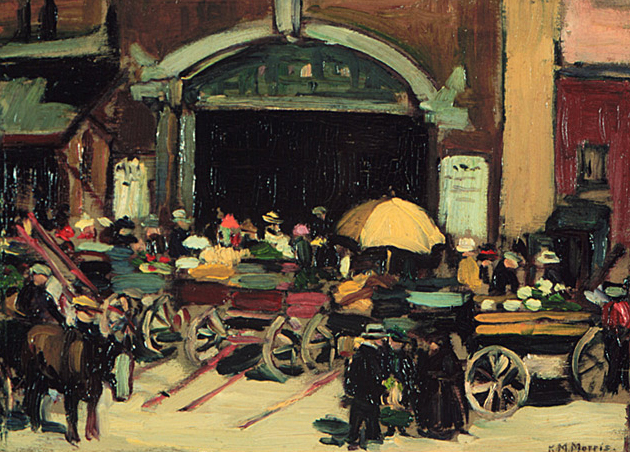
Kathleen Morris "Market, Ottawa" c. 1927 (National Gallery of Canada, Ottawa)

Peleg Franklin Brownell "Market, Ottawa" c. 1912 (sold at Masters Gallery)

Harry Britton "Market Day, Quebec" 1907 (sold at Masters Gallery)

Andre Bieler "The Market Stall" 1946 (sold at Masters Gallery)

Lawren Harris "The Corner Store" c. 1915 (illustrated in Duval, Where the Universe Sings, plate 106)

Friday, 12 February 2016

CANADIAN REALISM AND THE EGG TEMPERA REVIVAL

CANADIAN REALISM AND THE EGG TEMPERA REVIVAL

Niccolo Semitecolo tempera painting from 1367

Egg tempera is an ancient painting medium. For thousands of years tempera was the leading method for painting on walls, murals and panels. It might be best known for its use in medieval and early renaissance International Gothic style painting, before oil took over as the main medium of choice for painters around the beginning of the 16th century. Tempera paintings have the exceptional characteristic of retaining their vibrancy. A 600-year-old painting in tempera is still extremely bright with rich reds, blues, greens, yellows and more. Oil paintings younger than these will even appear more aged, as oil paintings darken over time. Egg tempera paint is a mixture of powdered colour pigments, egg as a binder, and some other agent such as water. Unlike oil paint, egg tempera dries almost immediately and does not spread around on surfaces at all. This may seem like a disadvantage, but it allows for an incredible degree of precision and detail that is less achievable with oil paint. Egg tempera paint can be layered for various effects and opacities without disturbing or mingling with underlying layers. This is because previously applied paint becomes insoluble to water once it has dried rapidly on its support. The precision and detail obtained with egg tempera comes at the price of requiring great skill and an abundance of patience. Each brushstroke is minute and must be tediously dabbed on in small un-blending lines to build up the overall image. One can see why the greater ease of oil painting took over when it was introduced. However, the end result of an artist’s work in tempera is undeniably impressive and exceptional.

Italian 15th century details of tempera paintings by Benozzo Gozzeli, Sandro Botticelli, Carlo Crivelli and Paulo Uccello

During postgraduate studies in art history, my classmates and I were required to sample this ancient painting method on typical gesso-primed supports in order to truly understand the massive effort and proficiency required of old master painters. We most certainly left the class with an even greater appreciation for the medieval masterpieces that we had been copying mere segments of. I found it very difficult and I finished with a copied out religious figure that looked stiff as a board and more greensick than holy. I have the uttermost appreciation for masters of this medium, and it is no wonder oil painting took over in the early modern era for ease.

Many historical revivalisms have happened throughout the 19th and 20th centuries, such as the Egyptian and Greco-Roman Revivals, the Gothic Revival, Medievalism, the Viking Revival and many others. Some revivals mimicked historical styles verbatim, where as others appreciated historical styles more indirectly through the use of revived art techniques and traditions from the past. Examples include the Arts and Crafts movement or the Woodcut Revival. During the 20th century there was also an Egg Tempera Revival associated with artists of various camps of realism in North America. They would not be the first to harken back to this technique, as the Pre-Raphaelites toyed with egg tempera in their quest to recreate the traditions predating Raphael and his contemporaries. In 20th century North America artists appreciated this age-old artistic tradition by honouring its use in their contemporary artwork.

JR Spencer Stanhope, Love and the Maiden, tempera, 1877 (Pre-Raphaelite)

An appreciation for traditional art methods made egg tempera an appealing medium to experiment with and master for these 20th century realists. Because realism is characterized by the intention to depict subject matter with verisimilitude and avoid stylization, the precision and ultra-detail of egg tempera was perfectly suited to capturing the almost optically photographic imagery of the style. This optical verisimilitude to reality was a feature of 20th century realism, regardless of whether an artist’s subset of realism was a movement such as naturalism (which heralded everyday life) or magic realism (which mimics the seemingly ordinary but inserts fantastical elements).

During the 1960s in Canada, a branch of realism organically grew out of the Maritimes. The group of artists whose work would show certain characteristics developed under the influence of its forerunner, Alex Colville, and indirectly by pioneering American magic realism, Andrew Wyeth. Alex Colville and Andrew Wyeth rose to international acclaim and prominence in the early 1960s for their efforts working in realism, despite the adversity that at this time the international art scene highly favoured the trendiness of abstract art. These two artists and their followers were able to overcome the overwhelming affinity that the art world had for abstraction at the time, and gained recognition for their art individually and as a collective. This included Wyeth and his followers and offspring in the US, and Colville and his pupils in Canada.

Andrew Wyeth, Blackberry Picker, tempera, 1943

Alex Colville, Family and Rainstorm, tempera, 1955

The renowned 20th century Canadian art scholar, Paul Duval, coined a term for this organically developed group of important Canadian realists and wrote a seminal publication about them in the mid-1970s. He called it High Realism, and it truly is an important international art development, and came straight out of Maritime Canada. He noted that following are shared features of High Realist art:

Objectivity of vision

sharpness of definition

precision of technique

accuracy of detail

excellence of craftsmanship

(From Duval, Paul. High Realism in Canada, 1975)

The above features, coupled with a deep respect for traditions in art, would lead many of the High Realists towards egg tempera. This method of painting peaked their interest because it was steeped in history and tackled the accuracy and detail these artists desired in their work. Thus through High Realism in the 1960s, Canadians were prominent in the 20th century revival of egg tempera painting.

There are many important Canadian High Realists who worked in other painting mediums, but because this blog is focused on Canadian involvement in the egg tempera revivals I will not be showcasing their work. I would like to give a peak at artwork by Canadian High Realists done in egg tempera.

Alex Colville used many mediums throughout his career, including tempera. He eventually settled on a modern equivalent that also dried very quickly, called acrylic polymer. Colville is well covered in publications, exhibitions and sales in recent times so I will not give further biographical details as we all know of his success. Another popular Canadian realist that achieved international attention for his artwork is Ken Danby. He had a stable financial existence through numerous professional artistic outlets- such as set design, television and newspaper illustration. He started out dabbling in abstract art during his spare time but was blown away by and Andrew Wyeth exhibition he came across at the Albright Knox Gallery in Buffalo late in 1962. A fervent commitment to resurrect his earlier interest in realist painting ensued, and he never turned back. He preferred rustic scenes and added his own touch to that which he observed around him. Paul Duval wrote that Danby, “…came to handle the difficult egg tempera medium with an almost virtuoso dexterity. Few artists have wrought from it such a remarkable variety of technical variations from the softest blendings to almost staccato textures.”

Alex Colville, Hound in Field, tempera, 1958 (National Gallery) and Soldier and Girl (Thomson Collection)

Ken Danby, the Mill Cat, 1968 (Private Collection)

Andrew Wyeth, Outpost, tempera, 1968

Tom Forrestall was nurtured to be a great draughtsman and artist from early childhood. He revered the work of old masters Titian and Rembrandt and considered a trip to continental Europe to be “one of the most useful experiences in his career.” He too studied under Alex Colville at Mount Allison University in Sackville, New Brunswick. Teaching and working as a cartoonist gave him enough income to be able to take his time painting on the side, and he could therefore begin to work with the labour-intensive egg tempera. Duval noted that Forrestall’s “choice of [egg tempera] was confirmed after examining the originals of Italian 15th century masters whose paintings in tempera on gesso remain as brilliant today as when they were painted.” Although his use of white gessoed panels is the typical support for egg tempera, his came in all sorts of unusual shapes and sizes. He cited ancient classical times as inspiration, as circles and ovals existed in classical art. He used these shapes and medium to project a contemporary perspective onto a lineage of artistic traditions.

Tom Forrestall, Best and Company, tempera, 1970 (Private Collection) and River Valley, tempera, 1971 (Private Collection)

While travelling through continental Europe was an inspiration for Forrestall, artist Hugh Mackenzie claims it was not a creative inspiration to him. His interest in egg tempera and high realism stemmed more from their being technically difficult and precise. His background in the arts was a mechanical illustrator. His job required that he make complex and accurate designs in drawing and he became highly proficient at perspective and intricacies as a draughtsman. Duval indicated that Mackenzie “…believes his three years as a mechanical illustrator deeply affected his future style and themes as a painter.” He also wrote that by 1966 Mackenzie had “perfected his personal egg tempera technique using a subtle combination of light washes and fine cross-hatching to slowly build his forms.”

Hugh Mackenzie, Girl and Volkswagen, tempera, 1968 (Private Collection)

These are just a few of the High Realist artists active in Canada from their heydays in the 1960s and onward. Acknowledgement of a handful of others includes Jeremy Smith, Bruce St. Clair, Fred Ross, Christopher Pratt, Christiane Pflug, and Patrick Cox.

By: JILL TURNER

Saturday, 9 January 2016

BACK TO WORK: THE ART OF WORKING LIFE

BACK TO WORK: THE ART OF WORKING LIFE

Two years ago in early January I wrote a blog about stretching the holiday season as long as possible like it was done in the period historically called Christmastide. This lasted all the way until January 5th or 6th with Twelfth Night on the eve of Epiphany. It is now past Twelfth Night and the holiday season has officially come to a close. Hundreds of years ago when Twelfth Night was as important a celebration as Christmas day, the Monday after it was called ‘Plough Monday’ and marked the day where everybody resumed their work. This is not unlike today, where many people return to work after enjoying time with friends and family between Christmas and the New Year. Returning to work and taking down all the decorations after extended festivities can be a difficult adjustment. However society couldn’t function unless hundreds of thousands of people are working hard at their jobs to contribute to the fabric of daily life.

Workers Making Bricks in the Tomb of Rekhmine, Thebes, Egypt

Throughout the ages artists have chosen a multitude of subject matters ranging from the most noble of events to the everyday grind of working life. Depicting people at work has been a subject of interest as far back as Ancient Egypt. The subject of working became forefront for artists in France in the 1850s as they started an art movement that celebrated and beautified the raw truth and reality of ordinary life without a sugar coating (this included depictions of hard work and labour) It was called realism and some big names of the movement include Jean-Francois Millet, Gustave Courbet, Jules Breton, and Jules Bastien-Lepage. Not that many years later across the English Channel in Cornwall, the Newlyn School of artists were following suit and producing painstakingly accurate, yet atmospheric, paintings of ordinary people at work in the fishing villages of the area. The movement expanded throughout Europe, Russia and America.

Jean-Francois Millet "The Gleaners" (1957)

Gustave Courbet "The Stonebreakers" (1849)

Jules Breton "The End of the Working Day" (1886-87)

Jules Bastien-Lepage "October" (1878)

Walter Barnsley "Breadwinners" (1896) [Newlyn School]

People at work became even better established as a subject matter during the First World War, where artists were commissioned to capture the activities of war through an artistic yet truthful eye without any glorification. Canadians were very involved in art documentation during World War I. Social realism continued to be a subject of interest during the interwar years and again very much during the Second World War.

As Canadian art arose into its own national entity from around the mid 19th century, it parallels the rise of the realist movement and thus throughout Canadian art history there has been a readiness to showcase ordinary life and work. From Cornelius Krieghoff onward Canadian artists have happily showcased ordinary working circumstances. Although Canadian art history promises a wealth of enchanting landscapes, artistry and beauty can also be found in the depiction of normal life and labours.

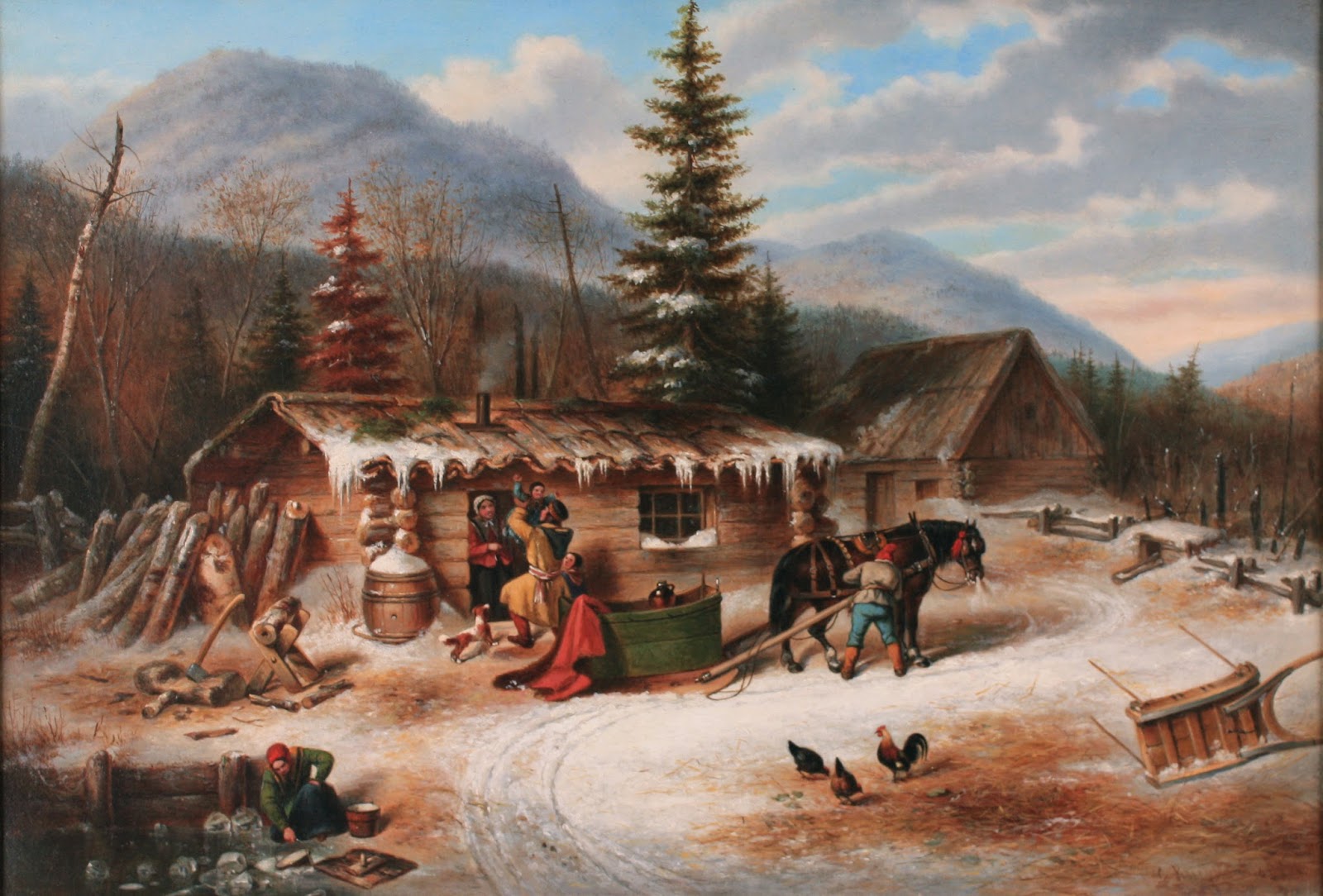
Cornelius Krieghoff "Settlers Camp Saint Maurice Valley" (1858) (Sold at Masters Gallery Vancouver)

The following is an assortment of Canadian art that I have chosen to illustrate the presence of working life as a subject in Canadian art. I have tried to cover different periods and regions. Wartime labour and agricultural work are the most prevalent. Perhaps because war effort and food production are crucial to the safety and sustenance of the nation, artists have recognized this and heralded these workers efforts. Some works are in public institutions and others are available at Masters Vancouver.

George Agnew Reid "Logging" (1888)[National Gallery of Canada]

Marc-Aurele Suzor-Cote "Retour des Champs" (1903)[National Gallery of Canada]

Dorothy Stevens "Munitions, Heavy Shells" (c. 1918) etching [Available at Masters Gallery]

E.J. Hughes "Early Morning PT Training" (1945) [Canadian War Museum]

Andre-Charles Bieler "Les Patates, Argentenay" (1929) [Art Gallery of Hamilton]

Fritz Brandtner "Road Laying" (circa 1940s) [Sold at Masters Gallery Vancouver]

Charles Comfort "A segment of the interior mural in the Toronto Stock Exchange" (1937)

Sybil Andrews "Ploughing Pastures" (1941)[Available at Masters Gallery Vancouver]

I hope you enjoyed these works of art that celebrate work. Now get back to work!

BY: JILL TURNER

Saturday, 5 December 2015

A TRADITION OF CANADIAN CHRISTMAS CARDS

A TRADITION OF CANADIAN CHRISTMAS CARDS

During the holiday season our country’s cherished artists scaled it down a notch to make small but memorable seasonal imagery for Christmas greetings that could be enjoyed by many people. In the colder winter months artists, such as the Group of Seven members and their contemporaries, spent time back in their studios selecting their favorite panel sketches of the year in order to make large-scale masterpieces on canvas. However, it appears that for the holidays they always made time for the more intimate art of Christmas card designing. This included hand-done cards for friends and family and designs for commercial cards as part of their jobs as graphic designers. These lovely little works came in varying printmaking techniques such as lithographs, silkscreens, linocuts, and woodblocks. Some are one-offs and might include hand-tinted highlights and others were made to sell in stores in series.

Mary Reid Wrinch Wyehwood Cardinals silkscreen printed Christmas card available at Masters Gallery Vancouver

Masters Gallery Vancouver held a printmaking exhibition this December, called Masters in Printmaking, which featured a handful of Christmas cards and designs. They have been very popular and well admired. Concurrently The McMichael Collection of Canadian Art in Kleinberg, Ontario has a Christmas card themed show derived from their own holdings and archives, This House was Made for Christmas. In this exhibition, and in our Vancouver show, there are some silkscreen printed Christmas cards. This comes in the wake of a Sampson-Matthews silkscreen exhibition in Masters Gallery Calgary in November to coincide with the launch of a book about Sampson-Matthews prints, Art For War and Peace. These all seemed like good reasons to focus this year’s holiday season blog on Canadian artists and their Christmas cards. Rous & Mann, Sampson-Matthews, and W. Coutts & Co. are a few of the companies that joined with our country’s greatest artists of the 20th century to make artistic Christmas cards.

JW Beatty silkscreen print of the Coutts Canadian Artist Series Christmas Cards

An AJ Casson design for a Christmas card in the McMichael Christmas Card show 2015

An AJ Casson Christmas card available at Masters Gallery Vancouver)

An AY Jackson silkscreen print of the Coutts Canadian Artist Series Christmas Cards

A Carl Schaeffer ink design for a Christmas card at the National Gallery of Canada

The custom of Christmas card giving began in the United Kingdom n the 1840s. Improved printing techniques throughout that century allowed for the Christmas card to become much more widespread by the 1860s. Cards also appeared sporadically in the late 1840s in America, but were expensive. An entrepreneurial printer mass produced cards at an affordable rate, and card giving took off late 1870s on this continent. By 1900 Christmas cards were popular all over Europe as well.

Three examples of Victorian (19th century) Christmas cards

An example of an e-card (21st century) for sending by email

By the early 20th century the Christmas card had become a mainstay tradition of the holiday season in those countries celebrating Christmas around the World. Although it appeared that email greeting cards might threaten the tradition of card giving a little bit, the custom of exchanging well-designed holiday cards has prevailed into the 21st century. There are now a handful of large chain stores devoted to selling high-end designer cards. It even seems as though there is a bit of a nostalgic resurgence of cards having the very vintage feel that harks back to the early card design and style. Throughout the 20th century, artists made cards that typically reflected their own style of artwork (though not always when working with larger graphic design firms). It is therefore a lovely way of seeing some renowned artists works on a smaller scale. For collectors these cards are increasingly popular and hard to come by. The following examples were available for sale in our Masters of Printmaking show.

Three AY Jackson Christmas cards from the Rous & Mann Canadian Artists series in the 1920s -Masters Gallery Vancouver

A hand-tinted Christmas Card by AY Jackson sold at Masters Gallery Vancouver

Sampson-Matthews, W. Coutts & Co., and other printing firms teamed up with Canadian artists to create Christmas cards, just as they did with the same artists for larger projects to promote Canadian art with the National Gallery. A.Y. Jackson was a particularly staunch supporter of organizing Christmas card creations with printing firms.The firm Rous & Mann produced a series of Christmas cards called the ‘Canadian Artists Series’ between 1923 and 1929. Household names like AY Jackson, AJ Casson, JW Beatty, Mabel Lockerby, LL Fitzgerald, Anne Savage, Sarah Robertson, Nora Collyer, Clarence Gagnon, Kathleen Morris, Ethel Seath, Paul Caron, Frederick Varley, LAC Panton, and likely more were involved. Then in the early 1930s Jackson approached William Coutts regarding submitting Christmas card designs to continue the tradition of promoting Canadian artists. From this meeting the Canada Painters Series of Christmas cards was set. With the designs of 26 known artists whom also had previously been involved as mentioned above, Coutts launched his series of just under 80 silkscreen Christmas card designs. Coutts pulled each silkscreen design himself by hand, and each therefore has an individual look. Frank Carmichael helped supervise this. The cards were stocked in stores, but were not particularly successful at first launch because the Depression Era had set in and prices were therefore to high for the average buyers. Incidentally, original Coutts 1931 silkscreen card designs are now desirable to collectors.

J. Ernest Sampson (of Sampson-Matthews) Cutting Down the Christmas Tree (1931) silkscreen print of the Coutts Canadian Artist Series Christmas Cards sold at Masters Gallery Vancouver

William Coutts did not give up, and went to the United States to meet with the Halls, owners of what became the Hallmark Co. in 1932. They agreed to take on a Canadian line of artists Christmas cards, an institution that continued with Hallmark until the 1980s. Hallmark in fact bought shares in W. Coutts & Co. and bought the whole company in the 1940s. Although Coutts’ 1931 silkscreens were unique and the medium attractive, likely for ease and practicality Hallmark used lithography after 1931. There have been a handful of exhibitions that have featured the Coutts series since, including a show and sale at Masters Gallery in Calgary in 2001.

Hopefully the seasonal imagery of these precious little greeting cards fills you with a bit of holiday cheer. Season’s greetings from all of us at Masters Gallery.

BY: JILL TURNER