THE GARDEN AS ART: Sculpture Gardens in Canada and Abroad
Around this time last year I wrote a blog called The Garden in Art as a nice topic to mark the start of summertime. I was just reminded of this blog, which focused on paintings depicting gardens, when a life-sized Leo Mol sculpture Sunny (1978) and the accompanying book about the Leo Mol Sculpture Garden arrived in the gallery this week. I thought I would write again about art and gardens, but from another standpoint. This time instead of writing about imagery of gardens, I will focus on the gardens that contain art themselves; in the form of art sculpture that can weather the outdoors.

(Leo Mol Sunny (1978) edition of 10)
Throughout the ages, art sculpture has been placed within gardens to enhance the décor. Some art sculptures are site-specifically installed as major components of a garden, and in the past have been quite elaborately designed. Other gardens exist especially to house a collection of sculpture by a single artist, or artists. Many varieties of the sculpture garden exist, and around the world there are sculpture gardens to suit various tastes from ancient to contemporary. They are outdoor galleries and museums that showcase artwork. The sculptural mediums of art that can be found in gardens are no less artistically creative than the paintings and drawings that hang indoors on the walls of homes, galleries and museums. Beginning with Canada’s very own Leo Mol Sculpture Garden, let us take a tour of some of the World’s great sculpture gardens.
The Leo Mol Scultpure Garden was created in 1992, and has expanded twice since then. It includes outdoor gardens of nearly 3 acres and 300 bronze sculptures (and a studio and gallery) within Winnipeg’s Assiniboine Park. It is a very popular destination for locals and visitors alike. Leo Mol is a Ukrainian-born Canadian artist who worked primarily in ceramics and bronze, and won many awards and commissions. He completed many figural works, including portraiture of Terry Fox, John Diefenbaker and Ukrainian poet Taras Shevchenko. The subject matter in the garden is diverse, and in a lovely botanical setting.
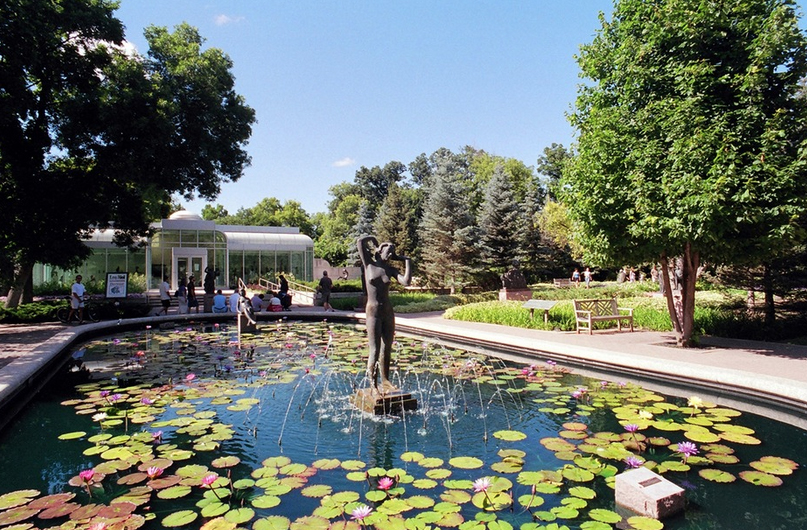


(Leo Mol sculptures in the Leo Mol Sculpture Garden, Assiniboine Park, Winnipeg, Manitoba)
I can think of some International equivalents to the Leo Mol Sculpture Garden that showcase the art of a single artist. Probably the most famous of these is the Garden at the Musee Rodin in Paris. They have a large garden dispersed with bronze casts of many of Rodin’s most well known sculptures, such as the Gates of Hell, The Thinker, and the Burghers of Calais. The garden is situated on 7 ½ acres surrounding the Musee Rodin.


(the Gardens at the Musee Rodin, Paris featuring The Gates of Hell, The Thinker and the Burghars of Calais)
Across the English Channel, in Hertfordshire is another sculpture garden dedicated to an Internationally famous artist of the 20th century, Henry Moore. The Henry Moore Foundation maintains a 70 acre garden with large-scale sculptures of his work at Perry Green. I should note that there are other sculpture gardens with Henry Moore sculptures elsewhere in England and the United States as well, and his work can also be found in gardens mixed with sculpture by other artists. We will mention a few of these shortly.


(Monumental Henry Moore sculptures at Perry Green Gardens, Henry Moore Foundation, Hertfordshire, England)
In Oslo, Norway there is an interesting solo-artist garden within the large central urban park, Frogner Park. This sculpture garden is a little bit different in that the sculptures are not just placed within the garden, but were created as an installation that is an architectural component of the park itself. This massive interactive installation was done by artist Gustav Vigeland, and is now a much-loved feature of the city of Oslo. The structural permanence of Vigeland garden within the landscape is reminiscent of the highly architectural sculpture designed for gardens in the Italian Renaissance.


(Vigeland Sculpture Garden, at Frogner Park, Oslo, Norway)
There are even more sculpture gardens around the world that are dedicated to displaying the work of not just one artist, but that of many artists. They vary in style and content quite significantly, from the gardens of the Museum of Modern Art in New York to the yearly garden exhibitions of contemporary sculpture at Chatsworth House and Gardens in Derbyshire, called Beyond Limits hosted by Sothebys.

(Sculpture Garden at the Museum of Modern Art, New York City)


(Sothebys Annual Beyond Limits Sculpture Garden Exhibition at Chatsworth House and Gardens, Derbyshire, England (pictures 1 and 2 sculpture by Alice Aycock picture 3 Damien Hirst sculptures))
Other gardens with modern and contemporary art include the 158-acre Frederik Meijer Gardens in Grand Rapids, Michigan and the 40-acre Lynden Sculpture Garden in Milwaukee which has over 50 sculptures including famous Russian Alexander Archipenko. The Yorkshire Sculpture Garden bosts sculpture by Joan Miro, Barbara Hepworth, Henry Moore, and many others. Set in a National Park in the Netherlands, the Kroller-Muller Museum and Sculpture Garden has 75 acres filled with sculpture by artists such as Rodin, Claus Oldenburg, Jean Dubuffet, Henry Moore, Lucio Fontana and other contemporary monumental works. Most of these are quite large, and cover many acres in beautiful settings.

(Frederik Meijer Gardens, Grand Rapids, USA)

(Sculpture by Amy Cropper at the Lynden Sculpture Gardens, Milwaukee, USA)


(Sculpture by Barbara Hepworth, Joan Miro and Sophie Rider at the Yorkshire Sculpture Gardens, England)


The Kroller-Muller Sculpture Garden, the Netherlands)
I mentioned above that I found a parallel between the in situ architectural element of the Vigeland Gardens in Oslo and those of the Italian Renaissance. The historian in me can’t help but also show some imagery from sculpture gardens of eras gone by. With the exception of the Vigeland Gardens in Frogner Park, most of the 20th and 21st century sculpture gardens that I have illustrated thus far are outdoor spaces where individual freestanding sculptures have been placed within the garden. However, in the past a lot of the sculptures meant for gardens were built to stay in situ as architectural elements of the garden, and were not necessarily freestanding objects that could be moved around if necessary.
Architectural sculpture was an integral part of grand scale gardens throughout many periods of the past. Most of the Italian Renaissance gardens of the nobility are like this, and show spectacular displays of sculpture in the form of fountains, grottos, capriccio ruins and fantastical beasts all carved in stone. Like with painting, sculpture in Italian Renaissance gardens changed according to the trends between the early Renaissance to the High Renaissance and then to the Mannerist style of the Late Renaissance. During the High Renaissance the ducal d’Este family created the gardens at the Villa de’Este in Tivoli (1550-1572) which survive today. In the late Renaissaince, Mannerism in painting lent to the exaggeration of features so that in contrast to the perfect linear, orderly geometric, atmospheric structure of High Renaissance painting, their was a shift to a less orderly and more fantastical style. This is seen in the gardens of this period as well, where the grotesque and unusual prevail. The best example of this is the surviving Sacro Bozco Garden at Bomarzo (1552-1584).


(High Renaissance Sculptural Gardens at the Villa d'Este in Tivoli, Italy)


Mannerist/ Late Renaissance fantastical sculpture garden of Sacro Bozco at Bomarzo, Italy)
This tradition of over the top magnificence carried on into the 18th century, where at Versailles we see architectural sculpture in the gardens of Marie Antoinette. Also at Versailles is magnificent monumental fountain and hydraulic masterpiece, called the Neptune Fountain. The fountain is carved with elaborate mythological subjects, and to this very day you can still watch the show of waterworks to orchestral music booming throughout the park.


(Sculptured Neptune Fountain in the gardens of Versailles, France)


(Sculptural elements in the gardens of Marie Antoinette's Estate at Versailles (18th c))
Whether a garden is adorned with site specific architectural sculpture or scattered with free-standing art work, they are equally as impressive a place to witness outstanding masterpieces of art as from within a gallery, or museum. The Leo Mol Sculpture Garden appears to be a very tranquil and beautiful place with an abundance of artwork by one of the nation’s best sculptors of the 20th century. This garden, along with all of the others highlighted worldwide in this blog, illustrates just one other way and form that art permeates into life and culture in many ways. I hope you all will get to enjoy visiting a garden or two this summer.
BY: JILL TURNER


