Tuesday, 4 March 2014

GENRE PAINTING IN CANADA 1860-1910

GENRE PAINTING IN CANADA 1880-1910

For me one of my most memorable paintings sold at Masters Gallery in Vancouver over the past year has been George Agnew Reid’s important masterpiece The Visit of the Clockmaker. This painting was exhibited at the World’s Columbian Exposition (aka the Chicago World’s Fair) in 1893 alongside another significant work by Reid called The Foreclosure of the Mortgage. The World’s Fair was an important international event that brought nations together to celebrate a worldwide diversity of arts and culture and industry and technology. The Visit of the Clockmaker and The Foreclosure of the Mortgage depict candid moments drawn from everyday life. They are 'genre' paintings.

George Agnew Reid The Visit of the Clock Maker 1892

George Agnew Reid The Foreclosure of the Mortgage c. 1892

Genre painting is defined as:

The pictorial representation in any of various media of scenes or events from everyday life, such as markets, domestic settings, interiors, parties, inn scenes, and street scenes.*

The term can be interchangeable with genre art, genre scenes or genre views. The scenes could be realistic, imaginary, or romanticized. Alternatively, a painting that depicts a moment frozen in time of an actual event from the past (but including religious, mythological, and allegorical subject matter) is called history painting. Historically (especially during the 19th century) a hierarchy of painting genres existed that ranked works based on prestige and cultural merit. The French Academy even had an ‘official’ rank. History painting was perceived to be the highest ranked and most noble of subjects for painting, and genre painting ranked third after portraiture and higher than still life, architectural views and even landscapes then. Genre painting was behind history painting and portraiture only in that it generally didn’t have an inspirational story or message necessarily.

Agreement with this hierarchy was particularly prominent in the 19th century French Salons and British Academies. However since the acceptance of 'modern art' this hierarchy no longer plays a role in evaluating the significance of paintings as it did in previous centuries. Particularly in Canada, where landscape painting has always been most prevalent starting with the topographical illustrations of colonial days through to the Group of Seven and right down until present day. However during the 19th century genre painting was not completely absent in the country. Though fewer in numbers, there were Canadian artists painting genre scenes more in fashion with what was most accepted on the European art scene, either in the Salons and Academies or amongst outside circles such as the impressionists or realists. Typically artists (not just in Canada, but elsewhere in Europe) looked mostly for inspiration at the Paris Salon and in art circles, or possibly also to the Academy in London or outsider circles such as the Pre-Raphaelites or the Newlyn School. Genre painting was common.

Francois-Joseph REim Charles V Distributing Awards to the artists at the close of the Salon of 1824 1827

In 1880 The Royal Canadian Academy of Art was founded. It was modeled more or less on the Royal Academy in London and other similar establishments. However, it did also aim to support Canadian art and noticeably artists drew subject material from Canada. The founding and early members of the Royal Canadian Academy were also in tune with academic painting in Europe and therefore often in addition to painting landscapes would paint a range from grand history scenes to genre scenes of a more mundane or intimate nature. History and genre paintings by Canadians still usually have a distinct identity with the country.

Interior of a Royal Canadian Academy Exhibition 1893

A Canadian Academician whose painting is stylistically similar to Reid’s Visit to the Clockmaker was Robert Harris’s A Meeting of the School Trustees now in the National Gallery. It is in academic style with rather grand gestures and title for a somewhat mundane daily occurrence. Harris manages to breath life into this realistic meeting. Masters Gallery sold a significant interior genre scene in the past by well-known art instructor and painter William Brymner, called Blackfoot Indians, Gleichen, Alberta.

Robert Harris Meeting of the School Trustees 1885

William Brymner Blackfoot Indians, Gleichen, Alberta 1907

Paul Peel is another of Canada’s well-esteemed early Academicians whose genre paintings are of a more intimate or romanticized type. He favoured the tender moments of everyday often with children, infants and mothers. Masters Gallery had a Suzor-Cote painting of a moving scene showing an intimate but more tragic side to everyday life at the turn of the century. It depicts a father a father agonizing over the bedside of his very sick child in a hospital ward. All though saddening, this is a beautifully rendered painting.

Paul Peel The Young Biologist 1891

Paul Peel The Young Gleaner 1888

Marc-Aurele Suzor Cote The Visit 1905

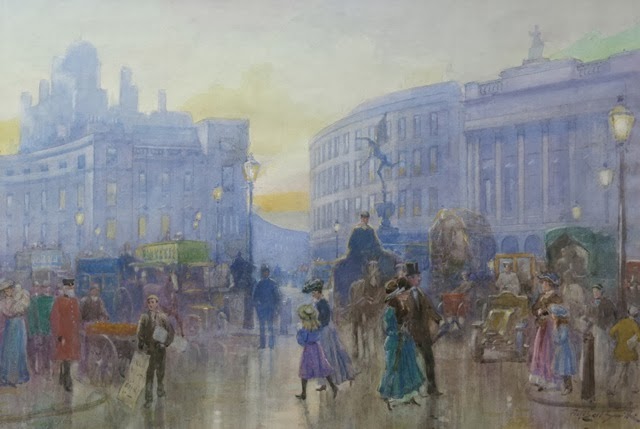
Canadian artists have also been known to depict outdoor scenes of everyday life such as markets or inns. Academician William Raphael’s masterpiece Behind Bonsecours Market, Montreal is a good example of such, as is Cornelius Krieghoff’s Jolie Fou tavern scenes. Frederic Marlett Bell-Smith is typically known for his watercolours of the Rocky Mountains, but he also spent a good portion of his painting career depicting the busy street life of cities like London and Paris. Masters Gallery has sold many good examples of these over the years.

William Raphael Bonsecours Market, Montreal 1866

Four Frederic Marlett Bell-Smith London scenes

Cornelius Krieghoff L'auberge Jolifou c. 1860

Having moved from Peel’s gentle genre scenes to illustrating illness, the aftermath of war, and tavern brawls I will return to a more lighthearted scene of everyday life during a Canadian winter. Charlotte Schreiber’s Springfield on the Port Credit depicts three children out playing in the snow with a sled. Schreiber was the second female to be inducted into the Royal Canadian Academy as a member.

Charlotte Schreiber Springfield on the Port Credit c.1880 (Private Collection, Ontario)

Lastly, I will illustrate work from another Canadian female who frequently painted genre works (though she moved permanently to the England to be with her also renowned artist husband Stanhope Forbes). Elizabeth Stanhope Forbes may have painted in a looser painterly manner than Charlotte Schreiber or George Reid, she utilized everyday life in Cornwall in her work to the fullest. Representing the common life in Cornish fishing villages was important to the Newlyn School painters, thus genre painting was typical for artists like Elizabeth and her husband. The Newlyn School shared common thoughts with French realist painters, whereby painting less than glamorous aspects of common life was considered.

Elizabeth Stanhope Forbes At the Edge of the Wood 1894

Stanhope Alexander Forbes A fish Sale on a Cornish Beach 1885

I hope that I have illustrated a fair number of excellent Canadian paintings in this whirlwind look at genre painting in the country.

BY: JILL TURNER

*definition taken from Wikipedia

Saturday, 22 February 2014

CHAMPIONS OF THE NORTH: RUSSIAN AND CANADIAN LANDSCAPE ART

CHAMPIONS OF THE NORTH: RUSSIAN AND CANADIAN LANDSCAPE ART

All eyes are still on Russia during this second week of the Sochi 2014 Winter Olympic Games. So far it seems that Russia has done a great job of organizing their Olympics and welcoming athletes and visitors. I think that Russia has excelled particularly well at aesthetically branding the Sochi Games. All of the graphic design is incredibly inventive, incorporating a patterned patchwork of traditional Russian arts and crafts motifs. I could be a bit bias about the effectiveness of the Sochi imagery however, because I have been a fan of Russian art since a friend gave me a book about traditional Russian lacquer work when I was about 15 years old. I eagerly immersed myself into learning about Russian lacquer work, and have long since moved on to appreciate a broader spectrum of Russian art and design; ranging anywhere from the costume and set design for the Ballet Russes in the 1920s, the late Imperial silver and enamel work of Karl Faberge and his contemporaries, painted Matryoshka dolls, and paintings of course.

I am particularly interested in Russian paintings of the late 19th and early 20th centuries (such as the well known Ilya Repin and his contemporaries who might be less widely recognized internationally). The Olympic graphics found all over Sochi on banners, bibs, billboards, and official apparel has reminded me what a rich artistic history Russia has had.

Ilya Repin (Russian)

Nikolai Dubovskoy (Russian)

Isaac Levitan (Russian)

In previous blogs I have noted my affinity towards late 19th/ early 20th century Scandinavian Art, and ultimately its significant relation to Canadian landscape painting. I thought that during the final days of the Sochi Games I would highlight some Russian landscape painting from this same period, and draw a few parallels to Canadian landscape painting. Russian art of this period displays a certain ‘northernism’ that suggests an attempt to use landscapes for patriotic purposes. Scandinavian and Canadian artists used their geography and climate as tools to promote the beauty of their nations and the stoicism of citizens. This was especially clear in Finland (such as artist Akseli Gallen-Kallela) and championed by the Group of Seven here in Canada. These countries all share a definite neoimpressionism modeled on the features of a northern landscape (evident through a different colour palette to French or continental European impressionism). These artists consciously utilized the land as a means of national pride.

Akseli Gallen-Kallela (Finnish)

Lawren Harris (Canadian)

Arkhip Kuindzhi (Russian)

Lawren Harris

Harald Sohlberg (Norwegian)

I am not the only one to think this either. When it came time to select some imagery for the blog, I went online to search Russian landscape painting. Without even adding the keyword Canadian to my search an online virtual exhibition at CHIN (Canadian Heritage Information Network) showed up called Spirit: An Expression of Transcendence, Russian and Canadian Landscape Painting 1860-1940. The tone of the article accompanying the virtual exhibit has a similar response towards the landscapes of the two nations as I do.

Group of Seven members, especially Lawren Harris, were vociferous about their goals to create a school of art that Canada could have pride in. The ‘northern’ landscape was the keystone behind their endevours. Incidentally, a very similar sentiment was felt by a group of Russian artists in the late 19th century called Peredvizhniki (The Wanderers). One of group members Isaac Levitan said:

I imagine such a gracefulness in our Russian land – overflowing rivers bringing everything back to life. There is no country more beautiful than Russia! There can be a true landscapist only in Russia.

Isaac Levitan (Russian)

Isaac Levitan (Russian)

Frank Johnston (Canadian)

A.Y. Jackson (Canadian)

According to Russian art specialist Christopher Ely, the:

Peredvizhniki painted landscapes to explore the beauty of their own country and encourage ordinary people to love and preserve it. Peredvizhniki gave a national character to landscapes, so people of other nations could recognize Russian landscape. The landscapes of Peredvizhniki are the symbolic embodiments of Russian nationality.

Arkady Rylov (Russian)

Arkady Rylov (Russian)

Franklin Carmichael (Canadian)

Tom Thomson (Canadian)

Arkady Rylov (Russian)

Arthur Lismer (Canadian)

Arthur Lismer (Canadian)

Vassily Perov (Russian)

Maurice Cullen (Canadian)

Arkhip Kuindzhi (Russian)

Lawren Harris (Canadian)

The group was influential upon the increased use of the landscape as an icon of national pride in Russia. The 43rd and final exhibition of the Peredvizhniki took place in 1923, just as the Group of Seven was at the height of exhibiting their work together. Most of the paintings illustrated in this blog are by members of the Peredvizhniki.

It is worth noting that genre and history painting were still very popular subjects in late 19th and early 20th century Russia, even amongst the Peredvizhniki. Yet somehow even these figurative paintings that told Russian mythological, historical, religious or folk stories were set within very distinctly 'northern' landscapes. This indicates how precious the Russian landscape had become as a symbol of national pride. Although genre and history painting are less common subjects in Canadian art history, paintings still exist and I will be discussing Canadian genre painting in the 19th century in the next blog.

Mikhail Nesterov (Russian)

Mikhail Nesterov

Mikhail Nesterov

I hope you enjoyed my sojourn into the realm of 19th century Russian landscape painting as well as the present day Russian-hosted Olympics.

BY: JILL TURNER

Photo Credits:

1. Sochi Olympics graphic design

2. Sochi Olympics banners

3. Giant Matryoshka 'Skier' on the Olympic Slopestyle Course

4. Cover of Book on Russian Lacquer

5a. and 5b. Alexander Golovin (Russian) Costume Designs circa 1910 for Diaghelev's Ballet Russes production of Stravinsky's The Firebird

6. Natalia Goncharova (Russian) A set design after Goncharova's original 1926 panel for the marriage scene in Ballet Russes production of Stravinsky's The Firebird

7. A wall of Matryoshka Dolls

8. Ilya Repin (Russian) A Parisian Cafe 1875

9. Nikolai Dubovskoy (Russian) Silence Has Settled It 1890

10. Isaac Levitan Lake. Russia. 1900

11. Akseli Gallen-Kallela (Finnish) Lake Keitele 1905

12. Lawren Harris (Canadian) Lake Superior Sketch II c. 1924

13. Arkhip Kuindzhi (Russian) El Brus in the Evening c. 1908

14. Lawren Harris (Canadian) a mountain sketch (Sold at Masters Gallery- highlights)

15. Harald Sohlberg (Norwegian) Winter's Night in Rondane 1914

16. Isaac Levitan (Russian) Golden Autumn 1895

17. Isaac Levitan (Russian) March, 1895 1895

18. Frank Johnston (Canadian) The Dark Woods Interior circa 1918

19. A.Y. Jackson (Canadian) (Sold at Masters Gallery- highlights)

20. Arkady Rylov (Russian) Evening circa 1915

21. Arkady Rylov (Russian) Sunset 1917

22. Franklin Carmichael (Sold at Masters Gallery- highlights)

23. Tom Thomson (Canadian) The Jack Pine 1917

24. Arkady Rylov (Russian) In Finland 1908

25. Arthur Lismer (Canadian) (Sold at Masters Gallery- highlights)

26. Arthur Lismer (Canadian) (Sold at Masters Gallery- highlights)

27. Vassily Perov (Russian) The Last Tavern at the CIty Gates 1968

28. Maurice Cullen (Canadian) The Bird Shop, St. Lawrence Street c. 1920s

29. Arkhip Kuindzhi (Russian) Sunlight on the Hoarfrost c. 1880s

30. Lawren Harris (Canadian) Snow-clad trees c. 1915 (Private Collection)

31. Mikhail Nesterov Vision of the Youth Bartholomew 1889

32. Mikhail Nesterov Girls on the River Bank c. 1890

33. Mikhail Nesterov Winter in Skit 1904